Twin Bed Size
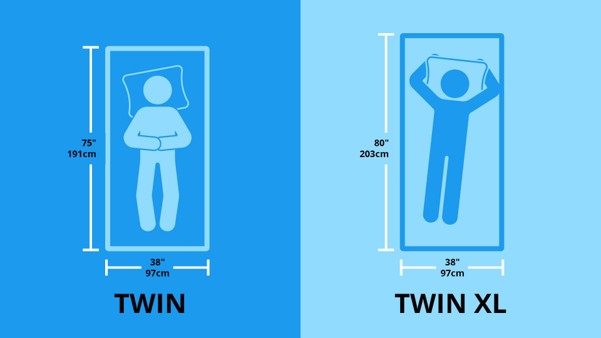
| Twin Bed Dimensions | Size (inches) | Size (cm) | Suitable For |
|---|---|---|---|
| Twin | 38 × 75 | 96.5 × 190.5 | Kids that have outgrown their cribs and single adults living in smaller apartments. It’s also great for a daybed or bunk bed. |
| Twin Bed Size Chart Reference Information : BedSizes.com | |||
About Twin Bed Size
The Twin Bed: A Complete Guide to Dimensions, Uses, and Considerations.
Introduction: Understanding the Twin Bed's Essential Role.
The twin bed stands as one of the most fundamental and ubiquitous bed sizes in American households and beyond. Known for its space-efficient design and versatile applications, the twin bed serves as a sleep solution for various life stages and living situations. This comprehensive guide explores every dimension of the twin bed, from its precise measurements and historical context to its practical applications in modern living spaces. Whether you're furnishing a child's first big-kid bed, optimizing a small apartment, or planning a multi-bed guest space, understanding the twin bed's capabilities and limitations is essential for making informed decisions about sleep furniture.
1. Precise Dimensions and Variations.
① Standard Twin Dimensions.
The classic twin mattress measures 38 inches wide by 75 inches long (approximately 96.5 cm × 190.5 cm). This compact size creates a sleeping surface that provides adequate space for a single sleeper while maintaining a minimal footprint—a crucial consideration in space-constrained environments.
② The Twin XL Variation.
For taller individuals or specific institutional settings, the Twin XL offers an extended length while maintaining the standard width:
Dimensions: 38 inches wide by 80 inches long (96.5 cm × 203 cm).
Primary advantage: Accommodates taller sleepers (up to approximately 6'6").
Common applications: College dormitories, hostel accommodations, taller teenagers' rooms.
Consideration: Requires specifically sized Twin XL bedding.
③ Floor Space Requirements.
Understanding the spatial footprint extends beyond the mattress itself:
Bed frame additions: Typically add 2-8 inches in each dimension.
Minimum room size: 7 feet × 10 feet (84" × 120") for basic placement.
Recommended room size: 10 feet × 10 feet for comfortable furniture arrangement.
Clearance standards: 24-30 inches on at least one side and at the foot for accessibility.
④ International Equivalents.
While dimensions vary globally, comparable sizes include:
United Kingdom: Single bed (90 cm × 190 cm / 35" × 75").
Europe: Typically 90 cm × 200 cm (35" × 79").
Australia: Single bed (92 cm × 188 cm / 36" × 74").
2. Historical Context and Evolution.
① From Children's Beds to Versatile Solutions.
The twin bed's evolution reflects changing social norms and living patterns:
Early 20th century: Primarily marketed as children's bedding.
Post-WWII era: Standardized dimensions emerged with mass production.
1960s-1980s: Became standard for college dormitories and institutional settings.
21st century: Embraced for minimalist living and space optimization.
② The Twin XL Innovation.
The introduction of the Twin XL addressed a significant limitation:
Emergence: 1970s in response to increasing average heights.
Standardization: Gained widespread adoption in higher education housing.
Modern applications: Expanded beyond dormitories to residential use.
3. Ideal Applications and User Profiles.
Primary Use Cases:
① Children's and Teenagers' Bedrooms.
Transition from crib: Typically occurs between ages 2-4.
Growth accommodation: Serves children through early teenage years.
Room sharing: Allows two beds in modest-sized children's rooms.
Safety considerations: Lower height reduces fall risk for young children.
② Space-Optimized Living Situations.
Studio apartments: Preserves living area while providing sleeping space.
Home offices/guest room combos: Easily accommodated in multi-purpose rooms.
Small bedrooms: In homes with converted spaces or historical properties.
Vacation homes: Efficiently maximizes sleeping capacity.
③ Institutional and Commercial Settings.
College dormitories: Standard in most higher education housing.
Hostels and budget accommodations: Maximizes occupancy per square foot.
Summer camps and retreat centers: Durable and space-efficient.
Medical facilities: Standardized for hospital rooms and care facilities.
④ Specialized Configurations.
Bunk beds and loft beds: The standard size for stacked sleeping arrangements.
Trundle beds: Pull-out second bed stored beneath primary twin.
Daybeds: Serves as seating by day, sleeping by night.
Side-by-side pairing: Two twins create flexible guest arrangements (often called "his and hers" configuration).
4. Advantages and Limitations.
① Significant Advantages.
Space Efficiency:
Minimal footprint: Occupies approximately 20 square feet versus 30+ for full beds.
Flexible placement: Fits in awkward spaces, alcoves, or converted areas.
Room sharing capability: Allows two sleepers in rooms as small as 10' × 10'.
Multi-functional rooms: Preserves space for other activities or furniture. Developmental Benefits for Children:
Safe transition: Lower height reduces fall risk from crib.
Independence: Appropriate size for self-management of bedding.
Room sharing: Teaches boundaries and sharing in appropriate personal space.
Gradual upgrades: Logical progression to larger beds as child grows.
② Important Limitations.
Sleeping Surface Constraints:
Width limitations: 38 inches may feel restrictive for adult sleepers, especially those who move frequently.
Length limitations: Standard 75-inch length insufficient for sleepers over 6 feet tall.
Couple sleeping: Not designed for two adults (except in separate twin arrangements).
Pets: Limited space for co-sleeping with pets.
Comfort Considerations for Adults:
Restricted movement: Side sleepers and those who change positions may feel confined.
Mattress quality: Often manufactured to lower price points than larger sizes.
Perception issues: Some adults associate twin beds with childhood or temporary arrangements.
Longevity Concerns:
Growth accommodation: Children may outgrow faster than anticipated.
Limited versatility: Less adaptable to changing life circumstances.
Resale value: Lower demand on secondary market compared to full/queen sizes.
5. Creative Applications and Pairing Solutions.
① The Twin Pairing Strategy.
Creating Flexible Guest Arrangements:
Two standard twins: Can be separated or pushed together.
Twin XL pairing: Creates king-size sleeping surface when combined.
Bed bridge: Foam insert minimizes gap between mattresses.
Separate bedding: Allows personalized comfort for each sleeper.
Specialized Connectors:
Mattress straps: Secure two twins together temporarily.
King-size topper: Unifies two twins as single sleep surface.
Split king adjustable bases: Individual control for each side.
② Multi-Purpose Room Solutions.
Home Office/Guest Room Combinations:
Daybed configuration: Serves as seating during day.
Murphy bed installation: Wall-mounted, folds away completely.
Sofa bed alternatives: Often more comfortable than convertible sofas.
Small Space Innovations:
Corner placement: Maximizes floor space in square rooms.
Under-bed storage: Utilizes vertical space efficiently.
Multi-level designs: Incorporate sleeping loft above work/living area.
6. The Verdict - When to Choose a Twin Bed.
Life Stage Recommendations:
Children (2-10 years): Standard twin with safety rails.
Pre-teens (10-13): Standard twin, consider Twin XL if tall for age.
Teenagers (13-18): Twin XL recommended for most.
College students: Twin XL (check dorm requirements).
Single adults in small spaces: Twin XL if over 5'8", standard if shorter.
Guest rooms: Twin XL offers most universal comfort.
Senior living: Consider mobility and ease of transfer needs.
Conclusion: The Enduring Value of Purpose-Driven Design.
In an era of increasing urbanization and shrinking personal space, the twin bed's efficient design takes on renewed relevance. For the city dweller maximizing a studio apartment, the parent creating shared space for siblings, the college administrator housing thousands of students, or the homeowner designing a flexible guest space, the twin bed offers a proven solution that balances comfort, space, and practicality.
The decision to choose a twin bed ultimately comes down to honest assessment of space constraints, user needs, and functional requirements.