Queen Bed Size
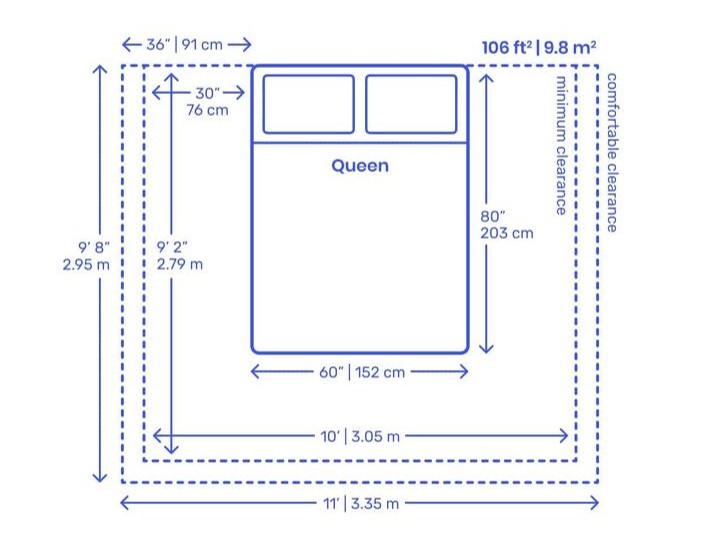
| Queen Bed Dimensions | Size (inches) | Size (cm) | Suitable For |
|---|---|---|---|
| Queen | 60 × 80 | 152.4 × 203.2 | Frequent choice and a perfect size for most couples that do not need a lot of sleeping space. If you plan to sleep alone this is more than enough. |
| Queen Bed Size Chart Reference Information : BedSizes.com | |||
About Queen Bed Size
The queen bed occupies a unique sweet spot in the bedroom furniture landscape—neither too small like a twin nor overwhelmingly large like a king. It represents the perfect compromise for millions of households worldwide, offering spacious comfort for couples while remaining manageable in average-sized rooms. As the most popular mattress size in North America and a close contender globally, the queen bed deserves thorough examination for anyone considering their sleeping arrangements.
The standard size and selection method for full Queen beds.
1. Queen Bed Dimensions: A Global Perspective.
Standard Queen Measurements.
① North American Standard (US/Canada):
Width: 60 inches (152.5 cm).
Length: 80 inches (203 cm).
Total surface area: 4,800 square inches (30 square feet or 2.79 square meters).
Common description: "Five by six-and-a-half feet".
② UK/Australia Standard:
Width: 150 cm (5 feet).
Length: 200 cm (6 feet 6 inches).
Note: Often called "King" in the UK, causing confusion for international shoppers.
③ European Standard:
Varies by country, but typically 160×200 cm.
French Queen: 160×200 cm (63×79 inches).
Scandinavian Queen: 160×200 cm or 180×200 cm.
④ Asian Variations:
Japan: "Semi-double" at 120×195 cm or 140×195 cm.
China: Often 150×200 cm or 180×200 cm.
India: Typically 60×78 inches (slightly shorter than Western standard).
2. Historical Evolution of the Queen Bed.
Mid-Century Origins.
The queen bed emerged as a distinct category in the 1950s, responding to post-war prosperity and changing family dynamics. Several factors drove its creation:
① Increased American height: The average American man grew from 5'8" in 1900 to 5'9.5" by 1950, necessitating longer beds.
② Suburban bedroom sizes: New tract homes had larger master bedrooms than pre-war apartments.
③ Consumer psychology: The "queen" designation appealed to aspirations of luxury and status.
④ Furniture industry marketing: Manufacturers sought to create a premium tier between "double" and "king".
The Standardization Movement.
Prior to the 1970s, bed sizes varied considerably between manufacturers. The International Sleep Products Association (ISPA) played a crucial role in standardizing dimensions, with queen beds settling at 60×80 inches by the late 1970s. This standardization coincided with:
① The waterbed boom (queen became the most popular waterbed size).
② Increasing divorce rates and more single adults buying beds for themselves.
③ The sexual revolution, changing attitudes toward couple sleeping arrangements.
Global Adoption Patterns.
Interestingly, queen adoption followed different trajectories internationally:
① Canada: Embraced the US standard quickly due to market integration.
② UK: Resisted the "queen" terminology but gradually adopted similar dimensions.
③ Japan: Created hybrid sizes reflecting smaller traditional housing.
3. Ideal Scenarios for Queen Beds.
Primary Applications.
① Couples in Average-Sized Bedrooms.
Perfect for rooms 10×10 feet (3×3 meters) or larger.
Provides 30 inches of width per person—adequate for most couples.
More intimate than king beds while avoiding the "cramped" feeling of full beds.
② Single Adults Who Value Space.
Luxury option for solo sleepers who enjoy spreading out.
Accommodates co-sleeping with children or pets.
Future-proof for potential partners.
③ Guest Rooms.
Universally comfortable for most visitors.
Accommodates single guests, couples, or parent with child.
More versatile than twin beds without overwhelming small rooms.
④ First Apartment/Home Purchases.
Represents a "grown-up" investment.
Balanced cost between full and king.
Fits most rental properties' master bedrooms.
* Statistical Popularity. According to the Better Sleep Council: 47% of American adults sleep on queen beds (the largest percentage). 35% of married couples choose queen over king (28%) or full (32%). Average ownership duration: 8-10 years. Peak purchasing age: 25-34 (first serious bed investment).
4. Spatial Assessment.
Minimum Room Dimensions:
① Absolute minimum: 10×10 feet (3×3 meters).
② Underestimating bedding costs - King duvets/comforters are expensive.
③ Comfortable minimum: 10×12 feet (3×3.6 meters).
④ Ideal: 12×12 feet (3.6×3.6 meters) or larger.
Traffic Flow Considerations:
Maintain 24-30 inches (60-75cm) walkways on at least two sides.
Consider bedside table space (typically 24 inches wide each).
Account for dresser drawers opening fully.
5. Specialized Queen Variations.
① Olympic/Expanded Queen.
Dimensions: 66×80 inches (168×203 cm).
6 inches wider than standard queen.
Requires special sheets and bedding.
Ideal for plus-sized individuals or those wanting extra room.
② RV/Short Queen.
Dimensions: 60×75 inches (152×191 cm).
5 inches shorter than standard.
Common in recreational vehicles.
Limited bedding options.
③ Split Queen.
Two 30×80 inch mattresses.
Allows different firmness on each side.
Compatible with adjustable bases.
Potential gap issues in middle.
④ Waterbed Queen.
Dimensions vary slightly (often 60×84 inches).
Heater and baffle considerations.
Special frames required.
Decreasing availability.
7. Cultural and Psychological Aspects.
① Social Status Perceptions:
Historically associated with marital beds and adulthood.
In some cultures, bed size correlates with prosperity.
The "master bedroom" expectation in real estate.
② Relationship Dynamics:
Space negotiation between partners.
Intimacy vs. independence balance.
Sleep divorce considerations (separate beds/rooms).
③ Psychological Comfort:
Security feeling from being "enveloped" in larger bed.
Childhood associations with parental beds.
The "safe haven" concept of the bedroom.
8. Decision-Making Checklist.
① Pre-Purchase Assessment:
Measured room dimensions and clearances.
Determined budget range (total package).
Identified primary sleeper(s) and sleep styles.
Considered any health conditions or special needs.
Researched return policies and trial periods.
Checked warranty terms and coverage.
② In-Store/Online Evaluation:
Tested mattress for at least 15 minutes in typical sleep position.
Evaluated edge support by sitting on perimeter.
Checked motion transfer with partner simulation.
Assessed temperature feel (foam may sleep warmer).
Verified foundation compatibility.
Compared multiple brands within price range.
Conclusion: The Enduring Appeal of Queen Beds.
The queen bed's continued dominance in the global market is no accident. It represents a pragmatic balance between spatial requirements, comfort needs, and economic considerations. For most adults—whether single or partnered—it provides adequate personal space without demanding mansion-sized bedrooms.
As sleeping technology evolves and lifestyles change, the fundamental appeal of the queen size remains: enough room to sleep comfortably, but not so much that it overwhelms our living spaces or budgets. It embodies the principle that sometimes, the middle ground is indeed golden.
When selecting your queen bed, remember that you'll spend approximately one-third of your life on it. This makes it not just furniture, but an investment in health, relationships, and quality of life. Take the time to choose wisely, considering not just immediate needs but how those needs might evolve over the 7-10 year lifespan of a quality mattress.